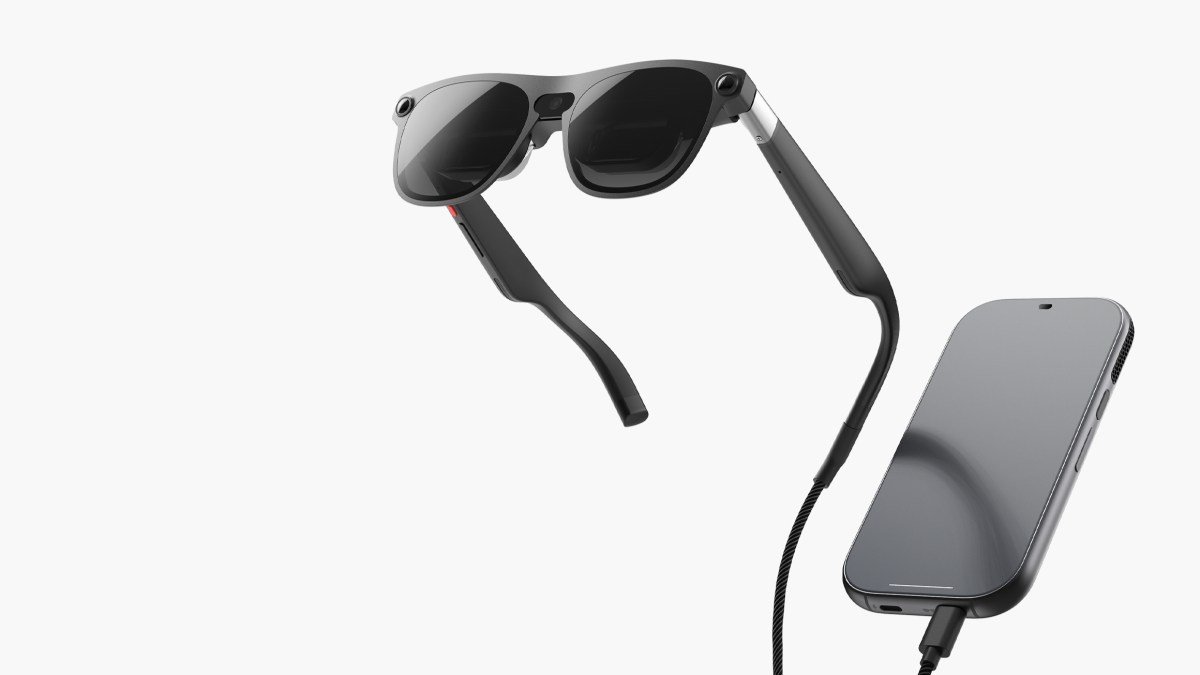
At the Android Dev Summit on Wednesday, Google’s smart‑glasses partner Xreal introduced the Xreal Aura, a wired headset that runs on Android XR and Qualcomm’s Snapdragon Reality Elite platforms. The device had been hinted at earlier in the year during Google’s I/O developer conference. As Meta pushes further into the smart‑glasses market, Apple and Google are also racing to bring their own products to consumers. Google is following the same model it used for Android phones, relying on a network of partners such as Samsung and Xreal to deliver devices built on its Android XR platform.
The Aura is not a standalone computer; it connects to a smartphone‑like processing unit that supplies the necessary power, while the glasses project the content directly into the wearer’s field of view. Its design resembles Meta’s smart‑glasses more than Apple’s larger Vision Pro headset. The glasses feature Sony’s Micro‑OLED display with a 1200p resolution, a 120 Hz refresh rate and a 95‑degree field of view, specifications that exceed those of the Ray‑Ban Meta Display on paper. However, the Aura is heavier at 95 grams compared with Meta’s 69‑gram model, and users must also carry the external processing puck.
At launch, the Aura supports a range of popular Google Play apps and games as well as dedicated XR experiences such as the NBA App for Android XR, Nevatars, Fallout: Factions, Project Hail Mary: Journey Among the Stars, the NASCAR XR App, and the San Francisco Ballet Company’s “The Nutcracker.” Through its USB‑C port, users can connect a computer or handheld gaming console, turning the glasses into an augmented display. The device can also be used for productivity, enabling multi‑monitor setups or a large virtual screen. Audio is handled by Bose technology, providing sound for video playback and music listening.
Because the glasses run Android XR, Google’s Gemini assistant is available as a Q&A helper, offering context for on‑screen content. The Xreal Aura is now available for order in the United States, Canada, Japan and South Korea. The 12 GB + 256 GB model is priced at $1,279, with a limited launch discount of $1,099 through December, while the 16 GB + 512 GB version costs $1,499, discounted to $1,299 for the same period. Shipping is slated to begin in mid‑November.
In May, Xreal CEO Chi Xu told TechCrunch that building a smart‑glass business is challenging and many companies are operating at a loss. He said the Aura’s broad range of use cases reflects an industry inflection point where hardware, software and design have finally aligned for scale. “You need all the key pieces ready — you need the hardware ready, the operating system needs to be ready, and then you need a great user interface,” Xu explained at the time.