Nearly two decades ago Nokia launched the 6300, a modest phone that arrived the same month Steve Jobs unveiled the first iPhone at MacWorld in 2007. Despite its simple design, low price and user‑friendly software, the 6300 became one of Nokia’s best‑selling models. In 2026 the original 6300 – not the newer 4G version – is a relic. It runs on a 2G network, and carriers that still support 2G are disappearing fast. Its web browser was never updated beyond TLS 1.0, and after Apple, Google, Microsoft and Mozilla retired that protocol in 2020, only about a quarter of websites still accept TLS 1.0 connections, leaving the phone unable to browse the modern internet.
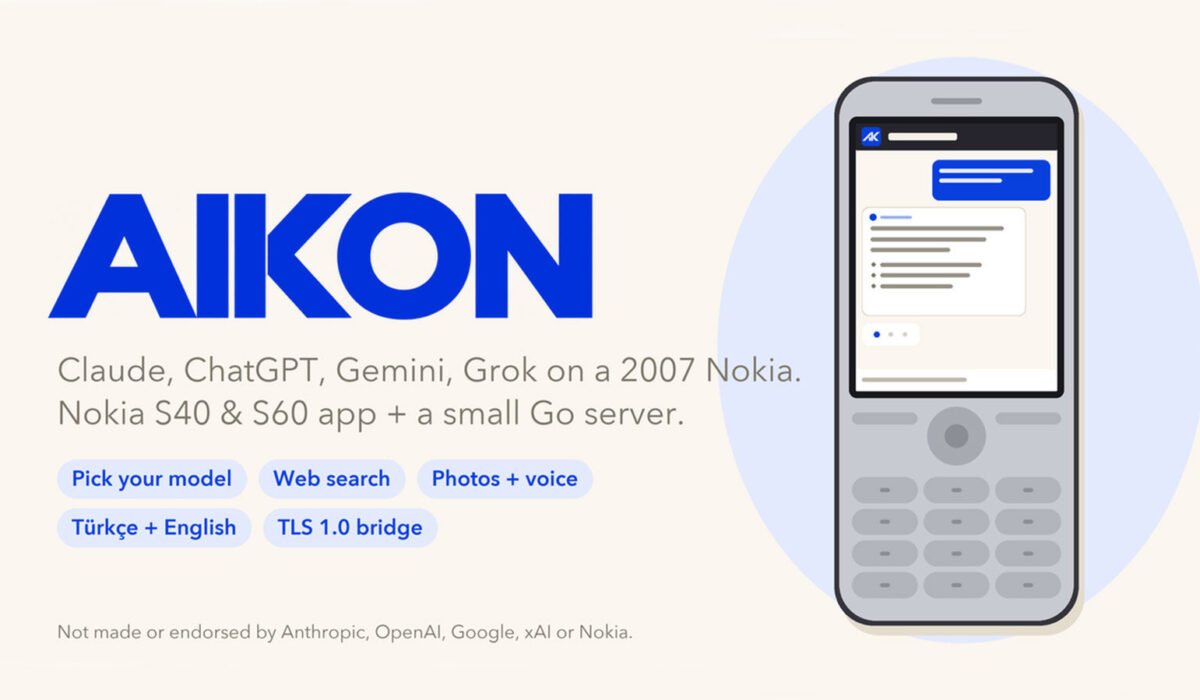
A Turkish entrepreneur named Emir Karşıyakalı has found a workaround that uses today’s AI chatbots to give the old device new life. In late September he posted on X about Claude S40, an app he wrote that lets the 6300 talk to the Claude chatbot via a Java and Go backend. Since then he expanded the software to support all the major chatbots – ChatGPT, Gemini and Grok – and renamed the project Aikon, which is “Nokia” spelled backwards, to reflect the broader compatibility.
To use Aikon you need a phone running Nokia’s S40 or S60 operating system and a separate Go server that stores the API key from Anthropic, Google, OpenAI or SpaceX SI. The server handles communication with the chosen chatbot and breaks the responses into 8 KB chunks that the 6300 can read. Because the solution relies on each provider’s API, users must also arrange token billing.
Although it is essentially a novelty, Karşıyakalı’s app is surprisingly polished. A dedicated keypad shortcut activates a reading mode that makes the 240 × 320 screen more comfortable for chatbot interaction. If a memory card is installed, responses can be saved for offline reading. Users can also send photos for analysis or record voice messages up to 30 seconds, with an OpenAI model converting speech to text. On the server side, Aikon retains messages for up to 30 days and supports English, Spanish, Portuguese, French, German, Russian, Indonesian and Turkish. The code has been open‑sourced so other developers can build on it.
One limitation remains: in the United States the app cannot run because the country’s last 2G network was shut down this summer when T‑Mobile turned off its old GSM service in August. Outside North America, anyone interested can download Aikon from GitHub and follow the provided installation guide.