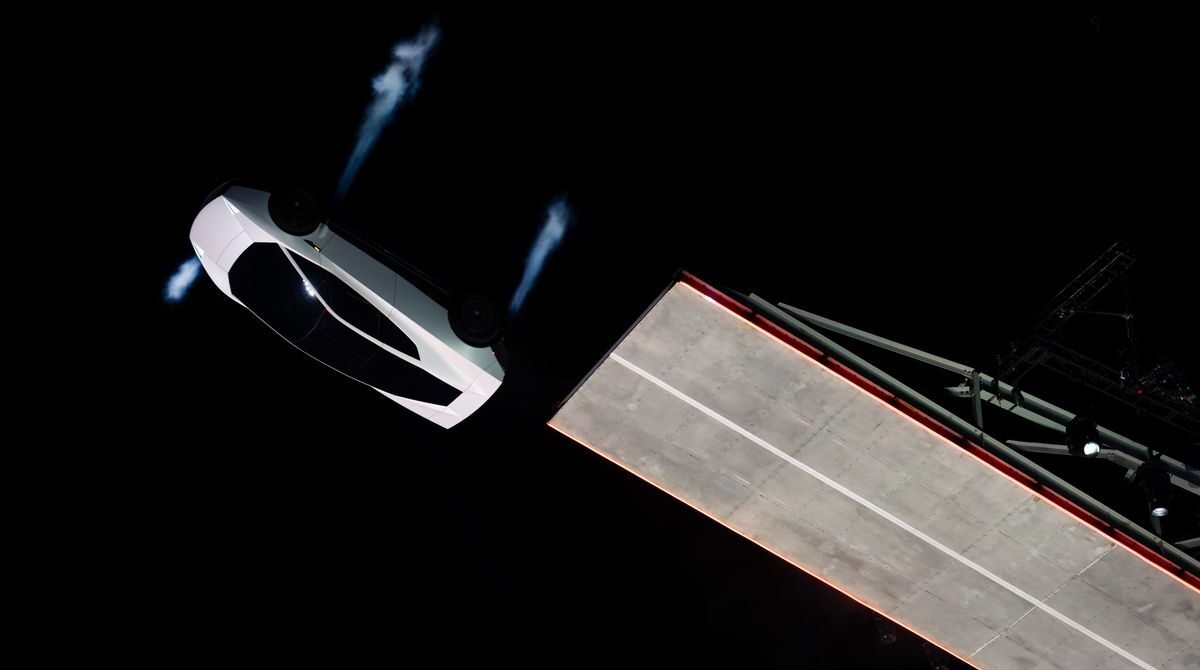
Tesla finally gave a glimpse of a “flying” car last week when Elon Musk unveiled the long‑awaited Roadster 2 prototype. The vehicle performed a series of stunts that ordinary cars cannot, including climbing a vertical wall and leaping over the entire current Tesla lineup. While regulators will decide whether such maneuvers belong on public roads, the physics behind them can be explained without legal jargon.
How the car climbs a wall
The Roadster 2 managed to drive up a circular ramp and remain stuck upside down, much like a superhero clinging to a surface. This feat relies on friction. When two surfaces touch—rubber tires on a road, for example—a static‑friction force prevents them from sliding relative to each other. The magnitude of that force (F f) equals the normal force (F N) multiplied by a coefficient of static friction (μ). The normal force is the component of force perpendicular to the contact surface, while μ depends on the materials involved. For rubber on asphalt, μ is roughly 0.6; the theoretical maximum for any pair of surfaces is about 1.
On a regular incline, the normal force decreases as the slope angle (θ) grows, which reduces the maximum possible friction. With μ = 0.6 the steepest angle a conventional car could climb without slipping is about 31 degrees, far short of vertical. Even a very high coefficient of 0.9 would only allow an incline of around 42 degrees.
To stick to a vertical wall, the Roadster 2 must boost the normal force dramatically. It does so with fans that pull air out from beneath the chassis, creating a low‑pressure region similar to a vacuum cleaner. The resulting pressure difference pushes the car against the wall, increasing the normal force and therefore the frictional grip.
A quick back‑of‑the‑envelope calculation shows how much pressure is needed. Tesla lists the target mass of the Roadster 2 at 1,700 kg and the contact area at roughly 2 m². Using the relation F = P × A and assuming the required upward friction equals the car’s weight (about 16,700 N), the pressure under the car must be about 86 % of atmospheric pressure. In other words, the fans must maintain a slight vacuum under the vehicle, a plausible figure given the design.
While the upside‑down demonstration makes for great marketing, the suction system also benefits normal driving. Greater normal force translates into higher friction, which improves acceleration, braking and cornering. High‑performance manufacturers have long exploited this principle, though not to the extent shown by Tesla’s prototype.
Accelerating to 60 mph in under a second
The Roadster 2 claims a 0‑to‑60 mph time of less than one second, a figure unattainable by a conventional car that relies solely on tire‑road friction. With a realistic coefficient of 0.6, the best a normal vehicle could achieve is about 4.6 seconds. The prototype, however, adds a second source of thrust: compressed air expelled from the rear, essentially a rocket engine.
The principle is the same as a toy car propelled by a balloon. When the balloon’s rubber contracts, it pushes air out through a nozzle; the escaping air has mass, so accelerating it requires a force. By Newton’s third law, the air pushes back on the balloon with an equal and opposite force, propelling the car forward. Tesla replaces the balloon with a high‑pressure air tank, generating a continuous thrust that supplements the tire friction and enables the astonishing acceleration claim.
Flying cars—sort of
The same compressed‑air system that provides forward thrust also lifts the Roadster 2 off the ground. By directing the airflow downward, the vehicle creates an upward reaction force that can briefly overcome its weight, giving the appearance of a flying car. That’s stretchi