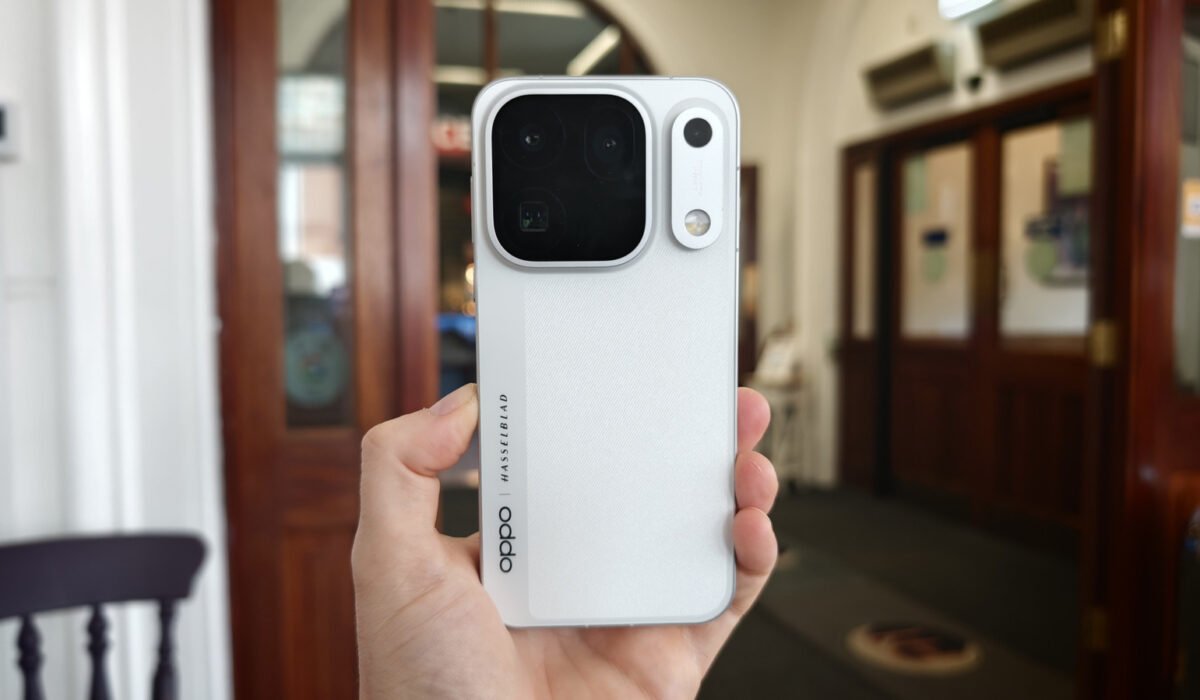
Oppo’s latest flagship, the Find X10 Pro Max, arrives in Europe, Asia and several other markets as the successor to last year’s Find X9 Pro and sits a step below the Find X9 Ultra. As with previous models, the phone is unlikely to be widely available in the United States.
The design is largely an evolution of the Find X10 line. Minor cosmetic changes include a dedicated color sensor and a flash placed beside the camera module. The handset retains the circular camera layout that distinguishes the Find X series, separate from the Ultra and the Find N6 foldable. An orange line traces the edge of the camera array, a subtle nod to Oppo’s partnership with Hasselblad.
The device feels more premium thanks to a matte‑finished aluminum frame and a back panel that, despite being textured, feels surprisingly smooth. It is offered in Luna White, which was used for this review, and Titanium Grey, the latter featuring a sleek, untextured rear.
The screen measures 6.78 inches, matching the X9 Ultra, and can reach a peak brightness of 3,600 nits, making it noticeably brighter than the X9 Pro. It supports an adaptive refresh rate ranging from 1 to 144 Hz, 10‑bit color depth and Dolby Vision. Oppo highlights faster color‑temperature adjustments in changing light, using a new “adaptive tone” mode powered by a five‑channel sensor. While the difference in color shifts is subtle, the auto‑brightness response feels quicker when moving between dim indoor settings and bright outdoor light.
Camera hardware remains the centerpiece of Oppo’s strategy, though the specs are a mixed bag. The Find X10 Pro Max houses three separate 200‑megapixel sensors for the main, telephoto and ultrawide lenses. In contrast, the Find X9 Ultra used a larger 1/1.12‑inch Sony sensor, while the new model adopts a 1/1.3‑inch Samsung HPC sensor, roughly 25 percent smaller. In side‑by‑side tests the Ultra performed better in low‑light scenarios, especially in Hasselblad Master mode that disables most computational enhancements.
Oppo introduces a “Lumo True” image engine that aims for natural colors and textures while dialing back aggressive AI processing. Compared with the X9 Pro and Ultra, the X10 Pro Max makes fewer speculative adjustments to text and pattern details. The telephoto lens offers 3× optical zoom and can use the 200‑megapixel sensor for a lossless 6× zoom, though it falls short of the 10× zoom found on the Ultra. The periscope telephoto also supports macro shooting down to a 10‑centimeter focal distance.
When compared directly with the X9 Pro, the X10 Pro Max shows improved low‑light autofocus and captures finer detail across all shooting modes. By default the phone renders full‑resolution 200‑megapixel shots into 26‑megapixel files throughout the zoom range, simplifying the workflow while still allowing a high‑resolution option for those who want every pixel.
Video features receive modest upgrades. Oppo’s DeepPix technology, built into the Samsung ISOCELL HPC sensor, promises up to 17 stops of dynamic range, a benefit that is more noticeable in video than in stills. The Pro Video mode offers open‑gate capture that utilizes the entire sensor area, giving editors more flexibility for cropping and re‑framing. It also supports Oppo’s O‑Log2 color profile, LUT previewing and integration with Blackmagic’s camera app. For creators seeking a full rig, Oppo has partnered with Tilta to offer a KHRONOS creator kit that includes a phone cage, grip, cooling fan and flash.
The optional teleconvertor system returns, now feeling sturdier than before. It consists of a specialized case, a teleconvertor lens that resembles a small pistol silencer, and a new adapter plate designed for the X10 Pro Max. While the lens itself is the same as the one used on the X9 Pro, the updated plate and case improve the overall feel compared with the earlier prototype.