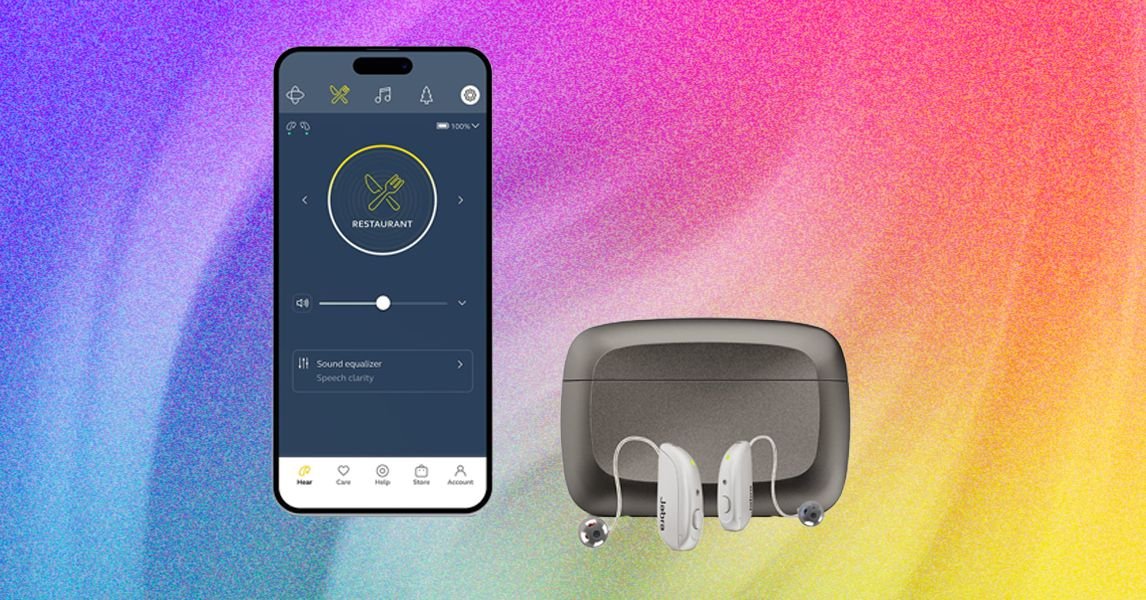
Jabra’s latest over‑the‑counter hearing aids arrived this fall as the company retired its Enhance Select 700, 500, 300 and 50R models, which were only a year or two old. The new line consists of three devices – the M3, M2 and M1 – that look and function much like their recent predecessors. Most of the changes are internal, and even those are relatively modest, as my testing of the M3 showed.
All three models weigh about 2.12 grams, varying only by a few hundredths depending on the ear tip. The M2 and M1 share an identical shape, while the M3 is slightly shorter, giving it a more compact profile. The only visual difference is the optional red color, which is offered only for the M3.
The aids follow the classic behind‑the‑ear teardrop design and feature a single button on the back. Different press patterns control power, volume and environmental modes, though the usefulness of those modes varies. Jabra calls its audio‑enhancement suite SoundScape, introduced last year to reduce background noise and improve speech clarity. The M3 adds two new SoundScape capabilities: an updated autofocus that “locks onto” speech in noisy settings such as restaurants, and an adaptive listening mode that automatically adjusts noise reduction based on the environment. In practice, the environmental presets were less helpful than manually tweaking the “all around” mode and noise‑reduction levels.
In quiet situations – one‑on‑one conversations, TV watching – the M3 delivered clear sound with minimal hiss when the volume was set around 30 percent. Raising the volume increased hiss noticeably. Bluetooth streaming remains a weak point for Jabra. The M3 supports Auracast, allowing multiple audio sources to stream directly to the aids, but the audio quality is only marginally better than earlier models. Music and movie soundtracks sounded washed out unless the volume was turned up to the maximum, and any ambient noise quickly degraded the experience.
The companion app and overall feature set are much the same as previous Jabra releases. Purchases include three years of access to on‑staff audiologists who can perform live tuning adjustments via video chat and provide user training. The built‑in self‑test can generate an audiogram in a few minutes. The charging case is large and unchanged; it holds enough power for three full recharges, and a single charge provides roughly 24 hours of use – I measured about 26 hours before needing to recharge.
Pricing has not shifted. The M3 launches at $1,995, matching the price of the former Jabra 700. Historically, Jabra tends to drop the price by around $200 after a few months, and coupons appear regularly, but the cost remains steep for a non‑prescription device. For comparison, the M2 is listed at $1,695 and the M1 at $1,195, and more budget‑friendly options are highlighted in the Best Hearing Aids buying guide.
Bottom line: if you can comfortably spend two thousand dollars, the M3 offers the most advanced OTC hearing aid currently available from Jabra. Those on a tighter budget will find the M2 or M1 nearly as effective for a substantially lower price.