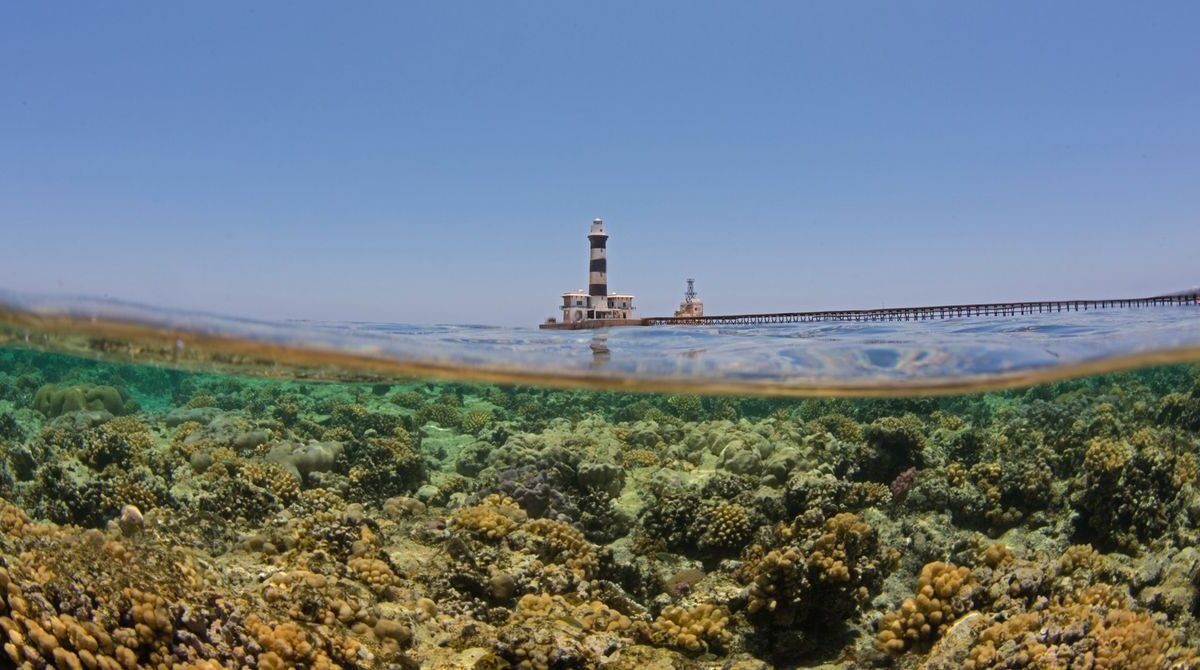
Coral reefs worldwide have suffered massive bleaching, but Egypt’s Red Sea reefs have long been seen as a hopeful exception. Their unusual tolerance to rising temperatures led some scientists, including Mahmoud Hanafy of Suez Canal University and consultant for the Hurghada Environmental Protection and Conservation Association (HEPCA), to suggest that the northern Red Sea could become the last refuge for coral worldwide.
That optimism was challenged by the heat waves of the summers of 2023 and 2024. A HEPCA survey led by Hanafi documented bleaching across the Red Sea in 2024. In the northern sector, fewer than ten percent of the colonies examined showed signs of stress, while in the southern part roughly half of the corals were bleached.
Researchers are now trying to understand what protected these reefs for so long and whether that shield will hold. In warm water, the algae living inside coral polyps produce toxic compounds; the corals expel the algae in a process known as bleaching, which cuts off their main food source and can lead to starvation. The loss of coral also threatens the myriad species that depend on reef habitats. The United Nations Environment Programme notes that reefs occupy less than one percent of the seafloor yet support at least a quarter of marine life, including many species still being discovered.
For many years the northern Red Sea remained relatively stable despite rising temperatures, prompting marine ecologist Eslam Osman of King Abdullah University of Science and Technology (KAUST) to point to the region’s evolutionary history. He explains that corals entered the Red Sea through the Bab al‑Mandab Strait, a warm passage between present‑day Djibouti and Yemen. The harsh conditions acted as a filter, allowing only heat‑tolerant species and genotypes to survive and later spread northward into cooler waters.
Hanafy, however, doubts that evolutionary legacy alone accounts for the reefs’ resilience. He emphasizes the role of water circulation. The northern Red Sea experiences shifts in current direction that can cause vertical mixing, pulling cooler, deeper water upward and tempering surface temperatures even when the air is hot. According to Hanafy, this mixing may have buffered the corals until the 2024 heat wave.
During that event, the sea remained unusually calm for about a month and a half, weakening the circulation that normally protects the reefs. HEPCA’s report identifies the reduced water movement as a key factor in the bleaching, and exceptionally low tides in July 2024 may have added stress to shallow coral communities. Osman acknowledges that calm seas could have intensified bleaching but stresses that temperature was the primary driver. “I’m not denying the possibility of that,” he says, “but what I’m saying is, the temperature was the main issue.”
The two explanations are not mutually exclusive, and determining their relative importance could help predict how vulnerable the reefs are to future heat waves. Early signs of recovery are encouraging. HEPCA’s preliminary estimates a year after the event suggest that 75 to 88 percent of corals have begun to rebound, depending on species and location—a far stronger recovery than many reefs worldwide, where progress is still uncertain.
Efforts to safeguard the Red Sea reefs are already underway. The Egyptian government has designated new marine protected areas and is collaborating with the United Nations Development Programme and the Global Fund for Coral Reefs on conservation and sustainable management. Osman views these initiatives positively but warns that lasting protection requires stable financial support. “We definitely need more stable financial resources, because conservation is not a single‑year act,” he says.
For Hanafy, the long‑term fate of Egypt’s reefs also hinges on whether climate change will alter the circulation patterns that may have kept them alive. “Therefore, the key is to reduce carbon dioxide and greenhouse gases. Any other solution will just buy time,” he adds.
The story was originally published in WIRED Middle East.