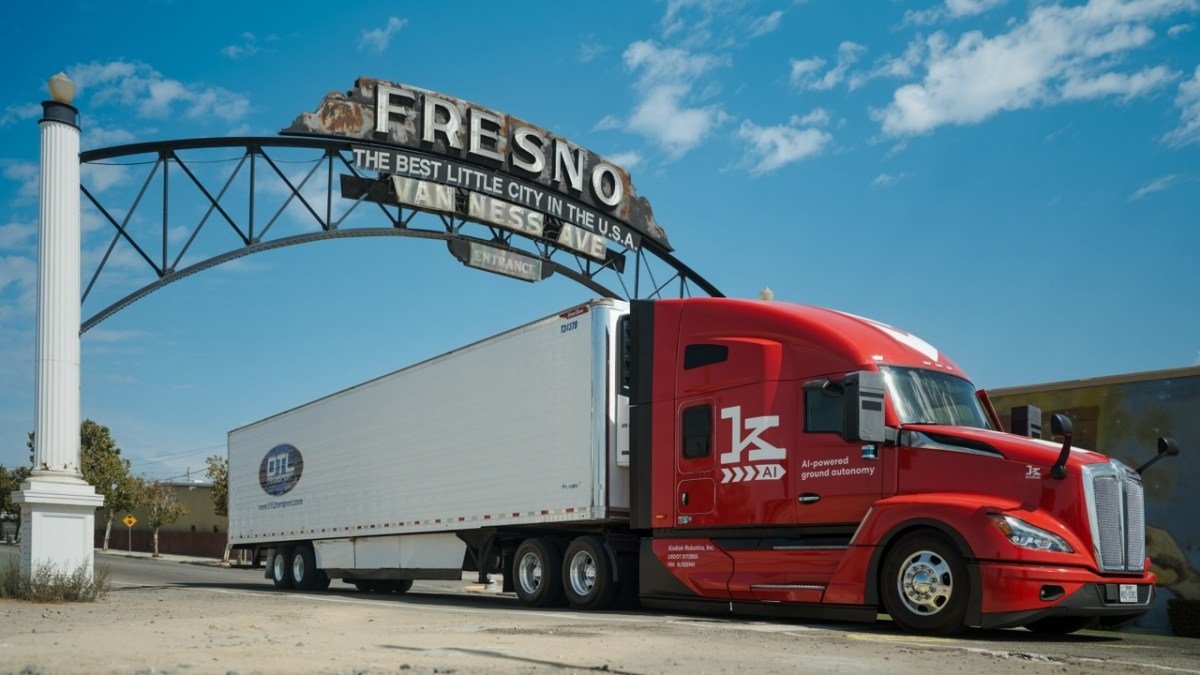
Kodiak AI announced Wednesday that it will begin delivering 75 autonomous trucks to California‑based freight carrier DTL Transport starting in 2028. The agreement marks the company’s first binding commercial contract for driverless big rigs that will operate on public highways.
The deal arrives just before Kodiak’s next major milestone: removing human safety operators from the cab to launch a fully driverless highway service in December. The company, which went public in September 2025, plans to debut the service by moving Ikea merchandise along Interstate 45 between Dallas and Houston.
DTL Transport, a mid‑market trucking firm that moves fresh produce and other goods to grocery chains, intends to deploy the autonomous trucks on several interstate corridors. The first routes will run from Dallas to El Paso, Texas, and along Interstate 20 between Dallas and Atlanta. Kodiak has already completed testing on both corridors.
“One of the things that we love about mid‑market carriers like DTL is that they can move with fast execution speed, much more at the speed of a startup or a small company or a tech company like Kodiak, and that they just want to get stuff done,” Kodiak founder and CEO Don Burnette told TechCrunch in an exclusive interview. “It’s easier for them to integrate into their fleet because they’re not as large, and we think that this is a real turning point for the self‑driving industry in general.”
The contract is expected to provide a much‑needed revenue lift for Kodiak, whose shares have fallen 87 percent from their opening‑day price. It also moves the company toward an “asset‑light” model in which it sells its technology rather than owning and operating trucks, a strategy shared by rival Aurora Innovation.
Today Kodiak works with several customers under a trucking‑as‑a‑service (TaaS) arrangement, including Charger USA, Roehl Transport and Werner Enterprises. In that model Kodiak owns and runs the autonomous trucks as a third‑party carrier, hauling freight for these firms on a handful of Texas routes. The company generates daily revenue on three active routes, but Burnette describes the operations as still being in a pilot phase.
Kodiak’s longer‑term goal is a driver‑as‑a‑service (DaaS) model, where customers own the trucks and Kodiak licenses the software, charging a per‑mile fee for the length of the contract. DTL becomes Kodiak’s first on‑highway DaaS client after a pilot program in California last month. During the trial, Kodiak autonomously moved perishable cargo for DTL about 225 miles along Interstate 5 and California State Route 99 between Fresno and Los Angeles, with a human safety operator in the cab.
“You have to prove out the technology first using your own truck, show them that it works, show them that it’s safe, show them that it integrates,” Burnette said of the TaaS approach. “And then we want to be asset light. We don’t want to be in the business of running a trucking company.”
Atlas Energy Solutions has been a DaaS customer since 2024. While technically the first client under a binding commercial contract, Atlas’s driverless trucks operate off‑road in West Texas’s remote Permian Basin. The energy firm currently owns and runs 35 autonomous trucks equipped with Kodiak’s system and aims to have as many as 100 in service by mid‑2027.
Kodiak did not disclose the financial terms of the DTL deal. However, a 2025 investor presentation projected annual recurring revenue of $150,000 to $190,000 per truck, based on a licensing fee of roughly $0.97 per mile, an assumed 225,000 miles driven per truck each year, and other factors. If those assumptions hold, the 75‑truck contract could generate about $11.2 million in annual recurring revenue once the full fleet is delivered.