Rivian has purchased Third Dimension, a British startup founded by veterans of the gaming and autonomous‑vehicle sectors that uses artificial intelligence to convert images and video into realistic three‑dimensional environments. The electric‑vehicle maker is not entering the gaming market; instead it plans to use the new technology to transform real‑world data into 3D simulations that can speed up the creation of its advanced driver‑assistance systems and the autonomous platform for the robotaxi service it intends to provide to Uber.
Financial terms of the transaction were not disclosed. Third Dimension’s 15‑person team, largely based in the United Kingdom, will join Rivian’s autonomy and AI group led by James Philbin. Philbin said the deal also lets Rivian broaden its AI hub in London.
Founded in 2024 by CEO Tolga Kart and Piotr Sokólski, Third Dimension raised $7 million in seed capital from investors such as Abstract Ventures, MVP, Soma Capital and Solari Capital. Although the firm originally built its technology to accelerate video‑game production, the founders identified additional uses in defense and autonomous vehicles. Under Rivian’s ownership, the focus will shift entirely to automated driving.
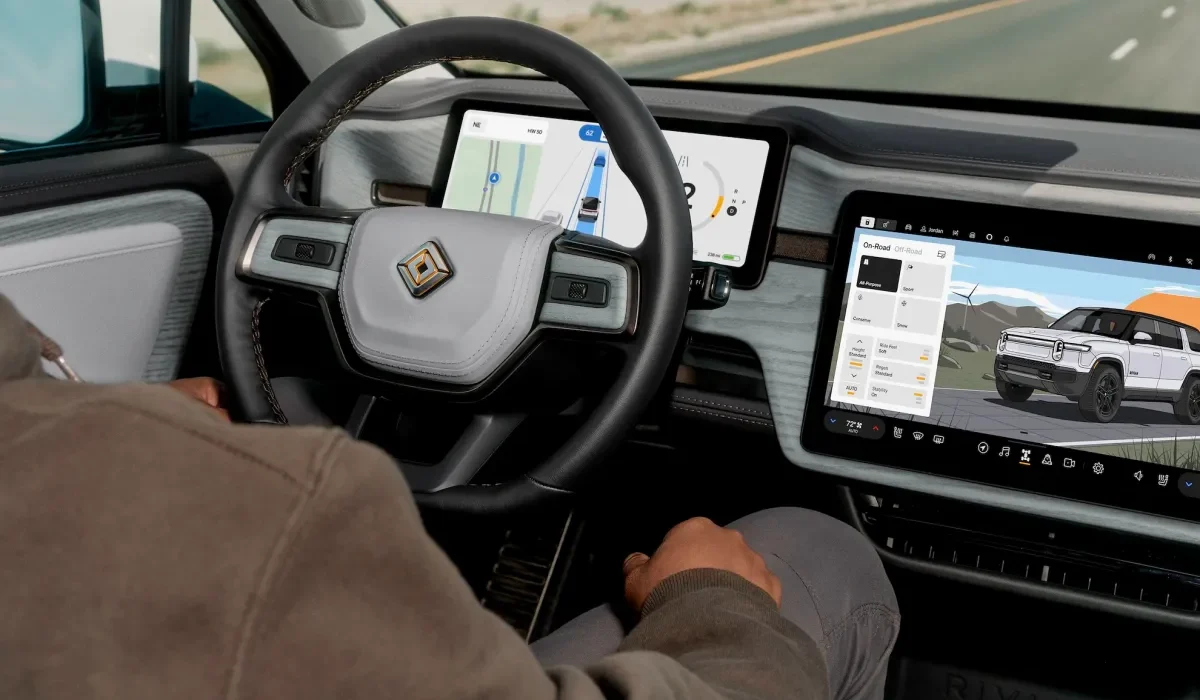
Rivian currently offers a “Universal Hands‑Free” system that allows drivers to remove their hands from the wheel on highways while still monitoring the road. The company aims to launch, by year‑end, a version that can navigate both surface streets and highways without driver input, though a human will still need to supervise and be ready to intervene. Full autonomy is slated for the robotaxi variant of its R2 SUV, which is expected to appear on the Uber platform in 2028.
“The team is excited to be able to focus on one problem,” Kart told TechCrunch. “I think as a small company, having to serve many, many different masters is very hard, and so we’re very excited to come work on a problem that has such an amount of scale, where our technology makes a true difference.”
Simulation is a key tool for developers of self‑driving cars, providing a way to train and validate algorithms. Traditional simulators rely on rendering engines or video‑game technology and often use synthetic data, which can leave a gap between virtual and real environments. Kart explained that while those simulators can look realistic, they still fall short of true fidelity. Third Dimension’s AI‑driven approach aims to bridge that gap by generating virtual worlds that closely match physical reality, a capability that could become valuable when paired with Rivian’s extensive data sets.
“For us, it’s about taking real scenarios, but making them simulatable,” Philbin said. “These are not synthetic kind of video game styles, they’re real things that happen in the world, but now we get that extra dial of being able to move the cameras around, shift other agents, have maybe different lighting or weather conditions. So it’s a really powerful tool for us.”
Philbin noted that Rivian had conducted a thorough evaluation of multiple providers before deciding on Third Dimension’s solution. Data volume and quality are both critical for autonomous‑driving development. Rivian gathers driving information from tens of thousands of R1T pickups, R1S SUVs, delivery vans and R2 SUVs currently on the road—any vehicle whose owner has opted in to share external‑camera data. The company aggregates and anonymizes this information to train its driving models, receiving more than 400,000 data sequences from its fleet each day.
With Third Dimension’s technology, Rivian will be able to simulate complex driving conditions without waiting for rare real‑world edge cases to occur. “Especially when you think about validation, right? So that’s really the piece where you’re saying, ‘is the system good to ship?’” Philbin said. “And there, you really want to have a good sense of this sim‑to‑real gap, because to do that kind of hand‑on‑heart, you really need to trust that answer is in the positive. Otherwise, you’re measuring something that’s not representative of how it will actually perform in the real world.”