Justin Mast’s career took an unexpected turn after he read a study about a houseplant connected to a motorized stand. The research showed that when the plant needed more light, electrical currents traveled through its tissues, prompting a control board to move the pot toward the light source. “I was like, what the heck?” Mast recalled to TechCrunch, describing the moment as his entry into a deep curiosity.
Teaming up with neuroscientist Lee von Kraus, who has previously worked with DARPA, Mast co‑founded Electric Plant. Over the past three years the company has gathered extensive data to train a large language model named Bombadil. The model is designed to read the faint electrical signals that run through a plant’s stem and convert them into actionable information for growers about the plant’s needs.
The founders envision a future where people can literally “speak” to plants, though Mast emphasizes that listening is the first step. To commercialize the sensors and Bombadil, Electric Plant recently closed an $11.2 million seed round led by Onto Ventures and Climactic, with participation from Ponderosa, Endeavor Catalyst, Ludlow, Michigan Rise, The Fund, Schox VC, and Dug Song.
Even in highly controlled greenhouse environments, growers often lack a clear view of what their crops require. Traditional tools such as soil probes, handheld spectroscopes and satellite imagery provide useful data but fall short of delivering real‑time insight into a plant’s internal state. “Those technologies are sophisticated, but their ability to get at the inside of the plant isn’t very sophisticated,” Mast said. “Most of that stuff still lags quite a bit behind the real‑time needs of the plant.”
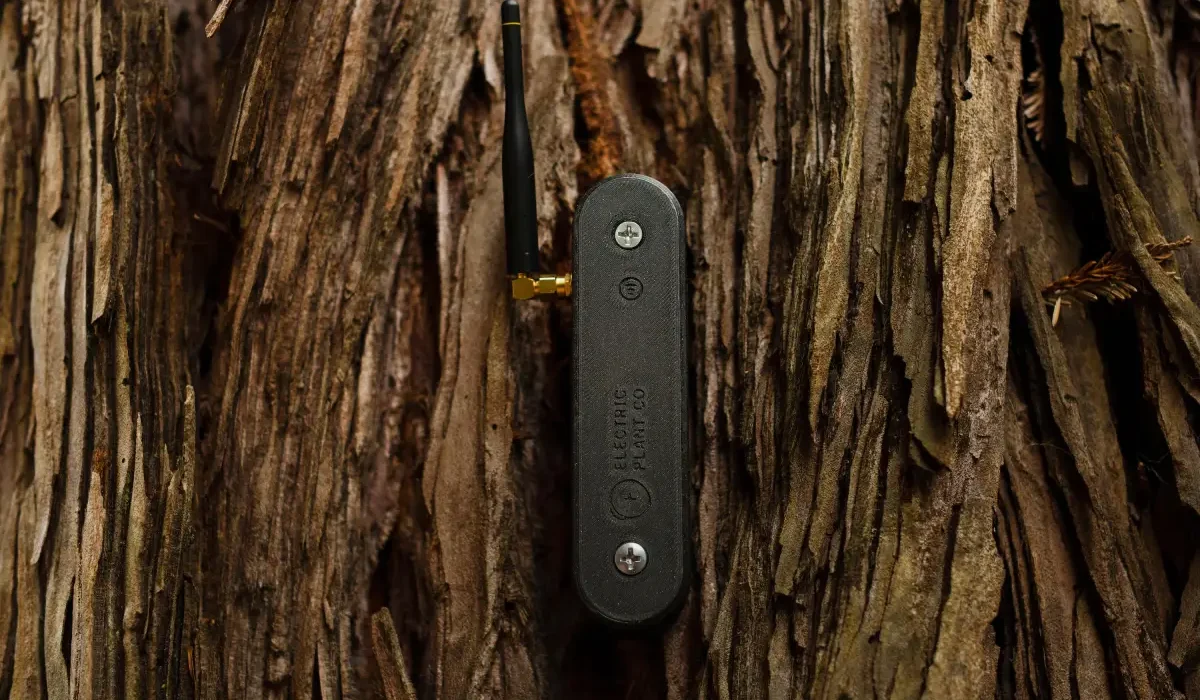
Electric Plant used those conventional devices as a starting point to train Bombadil, which now can interpret electrical activity in roughly 125 different species. Mast believes the model will outperform many existing instruments. The company’s sensors are also far cheaper, costing only tens of dollars compared with the thousands required for many current solutions. Each sensor, about the size of a folded iPhone, is attached to a plant with stainless‑steel screws that pierce the cambium—the living layer just beneath the bark—to capture microvolt fluctuations. Data travel via a low‑power wireless network to a base station, and only a few sensors per acre are needed for reliable readings.
Collected data are processed in the cloud by Bombadil, and the resulting recommendations are sent back to growers, who can adjust watering, fertiliser or other practices. Mast claims the system can raise yields while cutting water use by 20 percent or more. He did not disclose the identity of the startup’s first customers, but the technology appears suited for both agriculture and forestry.
Bombadil’s initial library includes more than a hundred plant types, ranging from ferns and redwoods to tomatoes and dahlias. “This is the most diverse model ever created on biological electrical signals,” Mast said. “No one’s ever done anything equivalent to this in the animal world.”