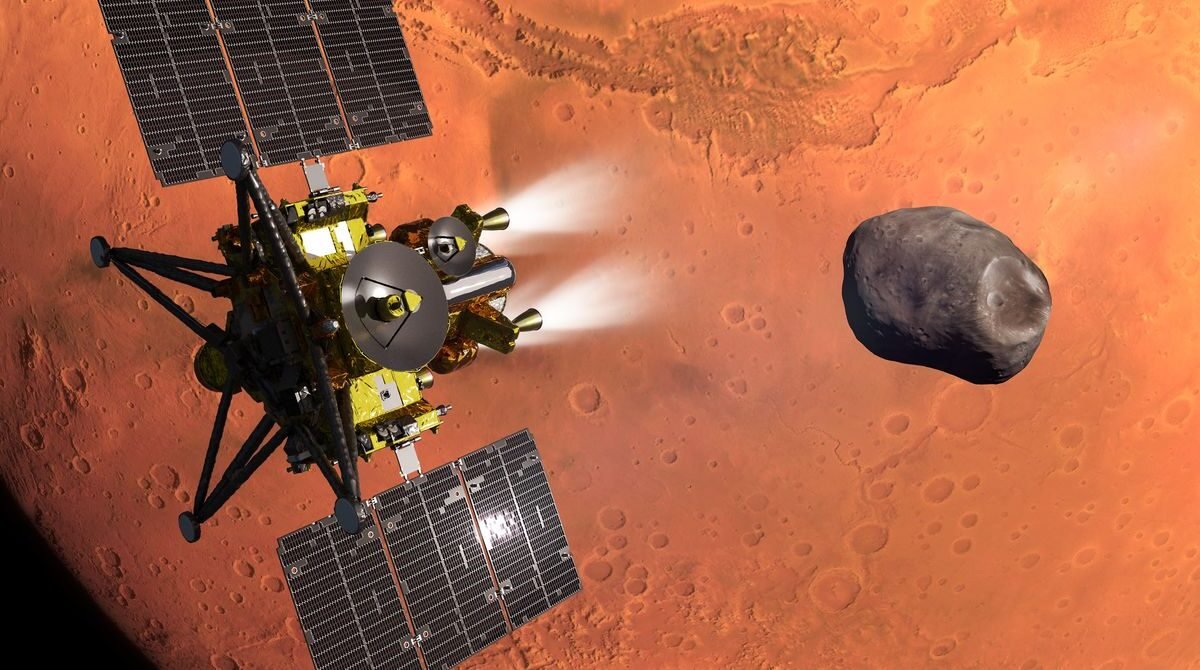
Japan’s space agency JAXA, together with a host of international partners, is preparing to launch the Martian Moons eXploration (MMX) spacecraft in the early hours of Tuesday Japan time (Monday afternoon in the United States). The probe will spend roughly a year traveling to Mars, where it will study the planet’s two small moons, Phobos and Deimos, before attempting to bring back material from Phobos.
The effort comes after three Russian attempts to reach Phobos since the 1980s all ended in failure. The origin of the two moons remains uncertain. Their reflectance patterns hint that they might be captured asteroids, yet their nearly circular, equatorial orbits suggest they could have formed from debris generated when a large body collided with early Mars. “The moons could be captured asteroids, or they could be the result of a giant impact,” said Tom Statler, MMX program executive at NASA, during a recent briefing.
MMX will carry a suite of instruments designed to resolve this debate. The MEGANE spectrometer will measure gamma rays and neutrons emitted by Phobos to determine its elemental composition. If the moon contains higher amounts of volatile elements such as hydrogen or potassium, the captured‑asteroid scenario would gain support; a lower volatile content would favor the impact hypothesis. “We know nothing about Phobos’ elemental composition,” noted David Lawrence, who leads the MEGANE team at Johns Hopkins University. “For me, that’s what’s exciting—making a measurement nobody’s done before.”
Abigail Fraeman of NASA’s Jet Propulsion Laboratory added that while the remote observations will provide valuable clues, the return of actual samples will be decisive. “The return samples are going to nail those questions,” she said.
After an initial survey of Phobos using onboard instruments and a small rover that will land ahead of the main spacecraft, MMX will touch down on the moon to collect at least ten grams of material. Two different sampling techniques will be employed to ensure success should one method fail. The mission plans to deliver the collected material to Earth by 2031, marking the first time samples are returned from a moon other than Earth’s.
Scientists believe Phobos’ surface may contain debris from Mars itself, offering a new window on the planet’s geological history. Laboratory analysis of the returned grains could also shed light on the composition of early solar‑system material and the processes that moved it throughout the planetary system, Statler explained.
Choosing a landing site is a particular challenge because little is known about Phobos’ terrain. Kiyoshi Kuramoto, who leads the international science team, said the mission will rely on close‑up observations before committing to a touchdown point. “Returning samples from a Martian moon is a world‑first challenge that is not easy,” he remarked.
The project draws on expertise from NASA, the European Space Agency, and the space agencies of Germany and France. “That kind of compounded set of expertise and contributions really helps make the mission objectives very achievable,” said Elliot Sefton‑Nash, MMX project scientist at ESA.
JAXA brings a strong record of sample‑return missions to the table. Its Hayabusa spacecraft returned material from asteroid Itokawa in 2010, and Hayabusa2 delivered samples from the primitive asteroid Ryugu in 2020. Many engineers from those missions are now contributing to MMX, though the different gravity and orbital environment of Phobos will present new challenges. “JAXA’s learned and achieved so much with their sample‑return missions that they are really well positioned to be able to do this,” Fraeman noted.
With a seasoned team and a clear scientific goal, the MMX mission aims to achieve what previous attempts could not: bring back a piece of a Martian moon for study on Earth.