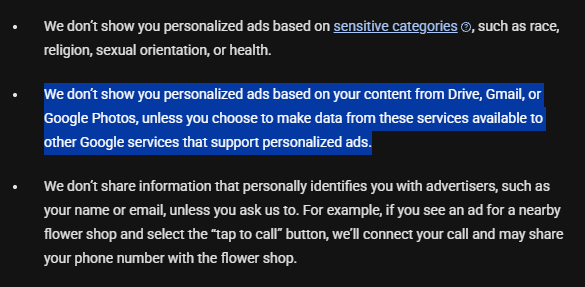
Using Google’s suite of products has always carried a degree of risk, as the company’s advertising empire relies on vast amounts of personal information. For years, Google assured users that data from services such as Gmail, Drive and Photos would not be used to tailor ads. However, a recent amendment to its privacy policy appears to remove that safeguard.
On October 16, Google rolled out a revision to its privacy policy, which was first noticed by Android Authority. The former ad‑personalization clause explicitly limited the use of data from certain apps, stating: “We don’t show you personalized ads based on your content from Drive, Gmail, or Photos.” The new version replaces that language with more ambiguous wording that suggests the possibility of using information from those apps when it is shared with other Google services.
The change could enable Google to draw on Gmail, Photos and similar data for advertising purposes, especially through a feature called Personal Intelligence. Launched in early 2026, Personal Intelligence lets users grant Google AI products access to data across multiple applications, with the promise that richer context will improve AI responses. Critics argue that this integration creates a privacy minefield, as it blurs the line between personal content and ad targeting.