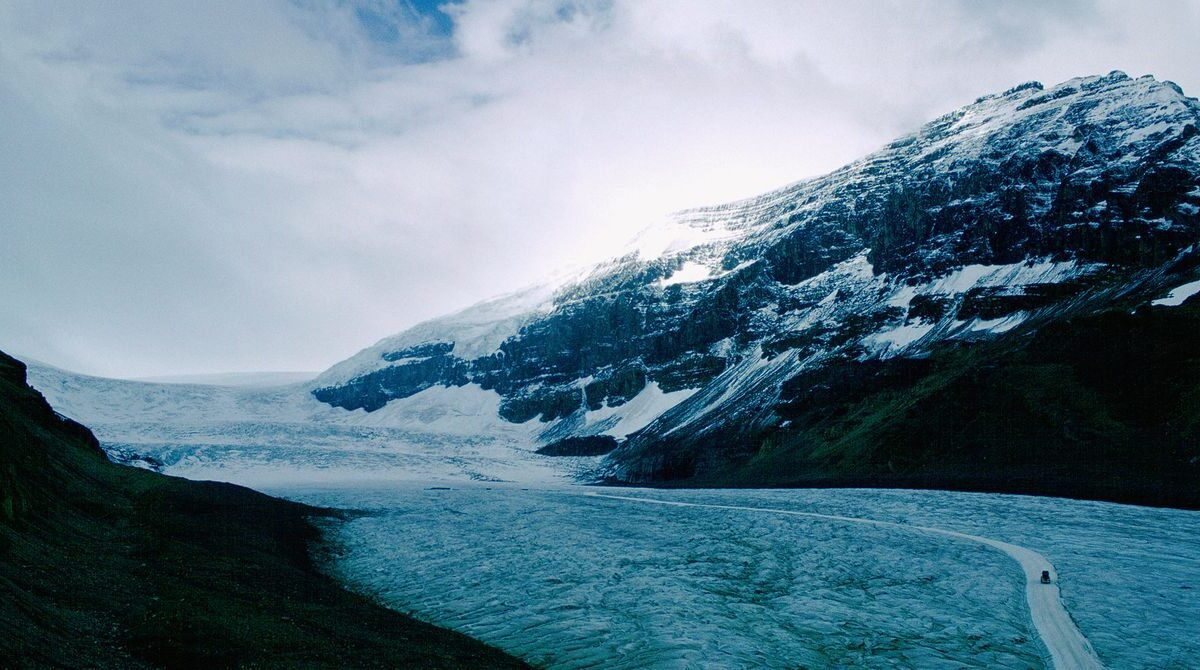
Burning fossil fuels may have prevented the planet from slipping into another ice age, according to a study released Thursday in the journal Science. By examining ancient plant remains and rock records, researchers traced the growth and abrupt decline of the Barnes Ice Cap, the last remnant of a massive ice sheet that once blanketed much of North America.
The study shows that the Barnes Ice Cap, which sits on Canada’s Baffin Island, began expanding a few thousand years ago but started shrinking rapidly in the 1960s as carbon emissions rose. “A question that’s in the popular consciousness is, have we caused enough global warming to stop the next ice age from happening?” asks Andrew Wickert, an associate professor of environmental science at the University of Minnesota Twin Cities, who was not involved in the work. He adds that the research indicates humanity’s early emissions have already been sufficient to trigger the retreat of a major North American ice sheet, a finding he calls significant.
Earth’s climate naturally cycles between cold periods, known as ice ages, and warmer interglacial phases due to variations in the planet’s orbit and tilt, the Milankovitch cycles. The most recent ice age ended about 12,000 years ago. At its height, the Laurentide Ice Sheet covered all of Canada and reached as far south as New York and the Midwest. Its remnants include the Barnes Ice Cap, an ice body roughly the size of Delaware on Baffin Island.
Unlike flowing glaciers, the Barnes Ice Cap is anchored to the bedrock, preserving a record of the vegetation that grew around it while it was covered. This unique characteristic allowed the scientists to determine how the ice cap has expanded and contracted over time.
To date the period when the ice cap first reached its present size, the team applied exposure dating, measuring the amount of Beryllium‑10 that accumulates on rock surfaces once they are exposed to the atmosphere. Their calculations suggest the ice cap attained its modern extent around 3,600 years ago.
The researchers then turned to the tundra’s modest inhabitants—mosses and lichens—to track later changes. “After the ice cap retreated, mosses eventually colonized this newly exposed land,” explains Nicolás Young, a paleoclimatologist at Columbia University’s Lamont‑Doherty Earth Observatory and lead author of the paper. “These mosses are living there, and things are normal—then, eventually, the ice cap starts to re‑expand. The ice covers the moss, and kills it.” The remnants of dead moss preserved in freshly exposed soils provided a timeline of the ice’s movements.
These biological clues indicate that the ice cap began to grow again about 2,000 years ago, a shift that may have marked the onset of a new glaciation. However, beginning in the 1960s the ice cap reversed this trend and started to shrink, a pattern that does not align with the expected progression toward another ice age. Using historic aerial photographs, the team documented a steady retreat of roughly four meters per year since the 1980s, coinciding with a sharp rise in carbon emissions that has driven ice loss worldwide. “Modern retreat of this glacier has reversed 2,000 years of net expansion—that’s a pretty decent chunk of time,” Young notes.
Meredith Kelly, an earth‑sciences professor at Dartmouth, praised the data as “awesome” and said the study reveals a clear pattern of the ice cap’s behavior. She suggested that comparing these findings with data from other locations would help clarify how the planet was moving toward a glaciation before human‑induced warming took hold. While scientists understand the broad triggers for ice growth, the precise mechanisms remain an active area of research.
Young adds that the new evidence also counters a long‑standing argument used by climate skeptics. In the early 1970s, scientists gathered at Brown University to discuss when the next ice age might arrive, concluding that a glaciation was imminent enough to warn President Richard Nixon. “I think this study actually helps show that scientists were right about a pending glaciation,” Young says. He notes that media coverage of that meeting and the cooler weather of the 1970s have been cited by deniers as proof that global warming is a myth. “It very much is, though, and the new research actually adds to the evidence.”