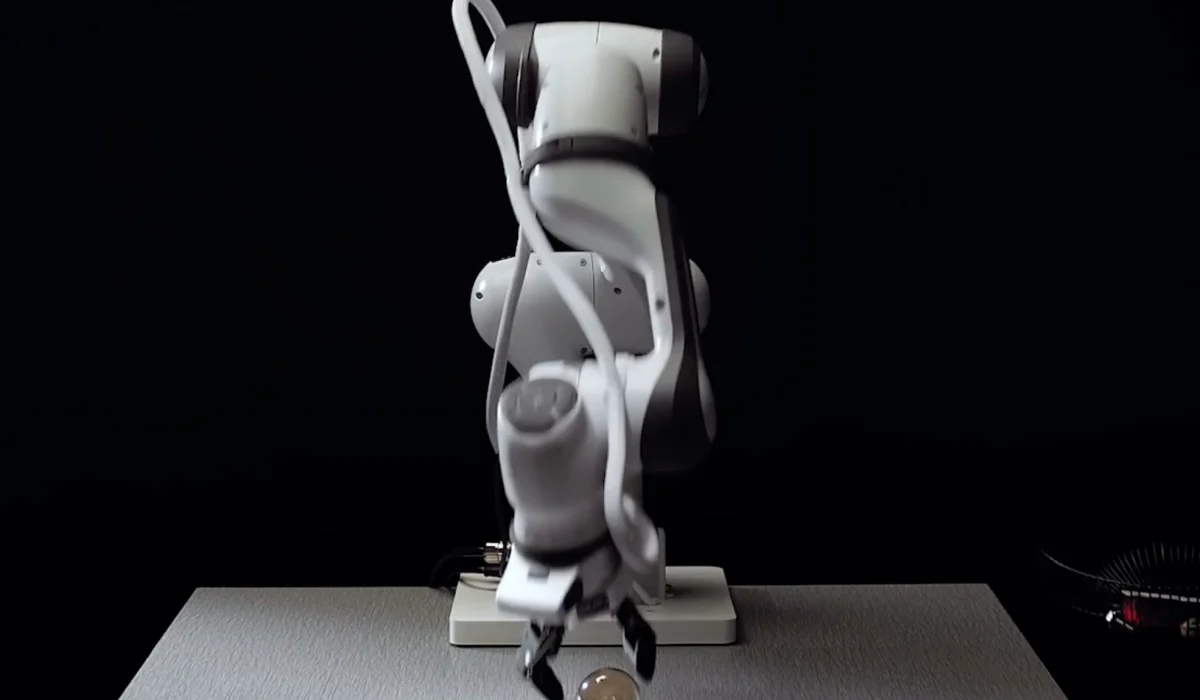
Robots have long struggled to pick up objects reliably, even after billions of dollars of investment and countless video datasets fed into deep‑learning systems. That situation may be about to shift thanks to a manipulation architecture created by Eka Robotics, which combines a force‑sensitive gripper with a novel deep‑learning model. The company, founded by MIT professor Pulkit Agrawal and former Google DeepMind researcher Tuomas Haarnoja, recently closed a $150 million Series A round that places its post‑money valuation at $1.45 billion. The round was led by venture firms a16z and F‑Prime.
Raghu Raghuram, the a16z general partner who co‑led the fundraising, told TechCrunch, “They are already exceeding superhuman performance for certain tasks, and so we think over the next few months there will be superhuman performance in many dexterous manipulation tasks.” In a landscape saturated with robotic demos, Eka’s results have surprised seasoned robot builders. Kris Hauser, a professor at the University of Illinois Urbana‑Champaign, described the demonstration as having a “wow factor” compared with other recent robot videos. He noted that the Eka robot “was able to adapt to a large number of different objects without retraining,” adding that it displayed a “humanness, creepy humanness that it would try over and over again if it failed the first time.”
A roboticist who asked to remain anonymous because of work at a frontier laboratory told TechCrunch that watching Eka’s robot felt as emotional as the first reliable legged‑locomotion breakthroughs a decade ago. The robot moves smoothly and quickly, capable of picking up roughly 1,500 items up to one kilogram each within an hour—about 600 more than a human can manage. Eka reports a success rate of more than 95 percent. The arm moves fast enough that it could damage itself, which the observer interpreted as a sign that the team “has a lot of trust in their algorithm not breaking the robot. I wonder how many robots they broke along the way?”
When the observer handed the robot a raspberry, a favorite test object at the lab, they recalled, “The experience of a big, heavy robot rushing towards my arm and then slowing down just in time and very gently touching me is a feeling that I am, as we speak, carrying this feeling in my body.” The robot’s gentle touch is a result of its underlying model. Instead of a vision‑language‑action framework, Eka uses a vision‑force‑action model that emphasizes the relationship between language, force inputs, and actions. Critics such as Rodney Brooks have argued that generative‑AI robotics will fail without a representation of force and touch; Eka’s performance appears to validate that concern. Co‑founder Agrawal explained to TechCrunch, “Vision is not the primary way in which you close this last millimeter problem. Vision tells you roughly where the object is, what the pose is, but the actual grabbing, the actual searching is happening through forces.”
To achieve this, the team designed a flexible robotic hand equipped with many force sensors that reacts to contact, preventing it from crushing delicate items like raspberries. While the founders keep specific technical details confidential for competitive reasons, they have said the approach relies on a physics simulator that models the multiple forces a robot encounters during a grasp. This simulation creates a reinforcement‑learning environment that can be scaled, allowing the generation of thousands of hours of robot experience in minutes. Hauser noted, “Rather than being limited to the data that you’re collecting from, say, human demonstrations, Eka is pushing through reinforcement learning this approach where the robot can surpass any kind of demonstrations that are given to it.” He added, “What’s really exciting is that they’re able to not be limited to the data that is presented to them for training.”
Agrawal and Haarnoja first met as graduate students at the University of California‑Berkeley and have become leading researchers in reinforcement learning for robotic control. Their key bet was that the technique could be scaled through simulation rather than relying on hours of video collected by gig workers or robot operators. Simulation proved essential for reliable manipulation, a challenge that has historically been harder for tasks involving direct interaction with objects.
“What Eka is bridging is the generality‑performance gap, which plagues a lot of modern robotics,” Agrawal said. Current physical AI models that aim for broad applicability often perform poorly on specific tasks, while models trained for a single task may lack commercial relevance. The promise of generative AI is that robots can quickly learn many, even novel, tasks. Existing approaches can make robots more generally intelligent—systems like Astra, the latest ChatGPT model, can operate a robot in an unfamiliar setting, but they do so slowly and at high cost. Eka’s model, by handling the physical manipulation, allows a more general AI to focus on decision‑making, potentially delivering faster, cheaper, and more versatile robotic solutions.