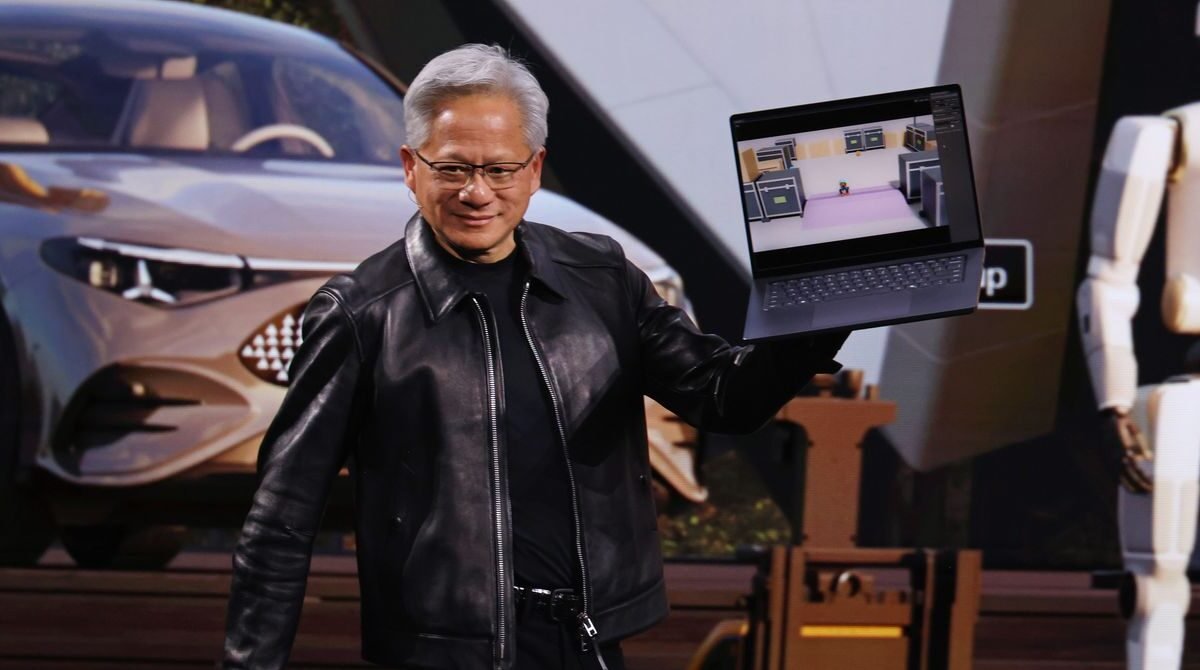
Jensen Huang painted a picture of Europe’s AI future during Nvidia’s global conference in Berlin on Wednesday, highlighting robotics, AI agents and modular data centers, all powered by Nvidia technology. “To be part of this AI economy, you don’t want to just be consuming the AI. You want to be producing the AI,” he told the audience of about 4,000 attendees at the GTC event. “We can do all of that here in Europe.”
The previous GTC, held in San Jose in March, focused on AI inference and more efficient computing. Seven months later the agenda shifted toward power, agents and physical AI. At the close of his 90‑minute presentation, small Microduck robots – created by Nvidia’s recent acquisition Hugging Face – performed on stage.
Huang’s first major announcement was a modular “AI factory” called the DSX Pod. The pod is a plug‑and‑play solution for AI data centers, arriving fully assembled in a large metal container equipped with Nvidia’s latest Vera Rubin compute racks. According to Huang, it can be operational in 14 days, a stark contrast to the months or years normally required for construction. He noted that the speed of deployment could be especially valuable in Europe, where infrastructure projects often move slowly, and that the pod would reduce idle time for compute resources. “This is a complete transformation,” he said.
The speech took place at Berlin’s Tempodrom, a venue that mixes circus‑tent architecture with gamer‑style lighting. Huang moved between product demos and broad industry predictions, positioning Nvidia as a core technology supplier across sectors. During the talk two Greenpeace activists stood up with a banner reading “Clean up your dirty business.” Huang instructed security to “go easy” as they were escorted out.
Humanoid robotics, Huang claimed, will become the next great industry, and Europe’s manufacturing legacy makes it well suited to lead. He emphasized that physical AI extends beyond robots, noting that telecom operators are now installing Nvidia GPUs in cell towers. He also announced collaborations with European automakers Volkswagen and Mercedes on autonomous vehicles.
In the robotics arena, Nvidia will launch a full‑stack platform to standardize robot configuration, and will offer a pre‑configured reference robot named Agile One in the first quarter of next year to help developers build physical AI systems. “This is your great opportunity,” Huang said.
Regarding model usage, Huang predicted that every future company will employ both closed‑source and open‑source models that they customize. He demonstrated Nvidia’s own open‑source models achieving frontier performance after being fine‑tuned on proprietary data. He also forecast that AI agents will increase the number of software tool users, as agents’ reasoning, iteration and tool use drive higher token consumption and greater demand for computing power – and therefore Nvidia GPUs.
To wrap up a technically dense presentation, Huang played an AI‑generated Eurovision‑style song that summarized his announcements, making the final moments more accessible for the audience.