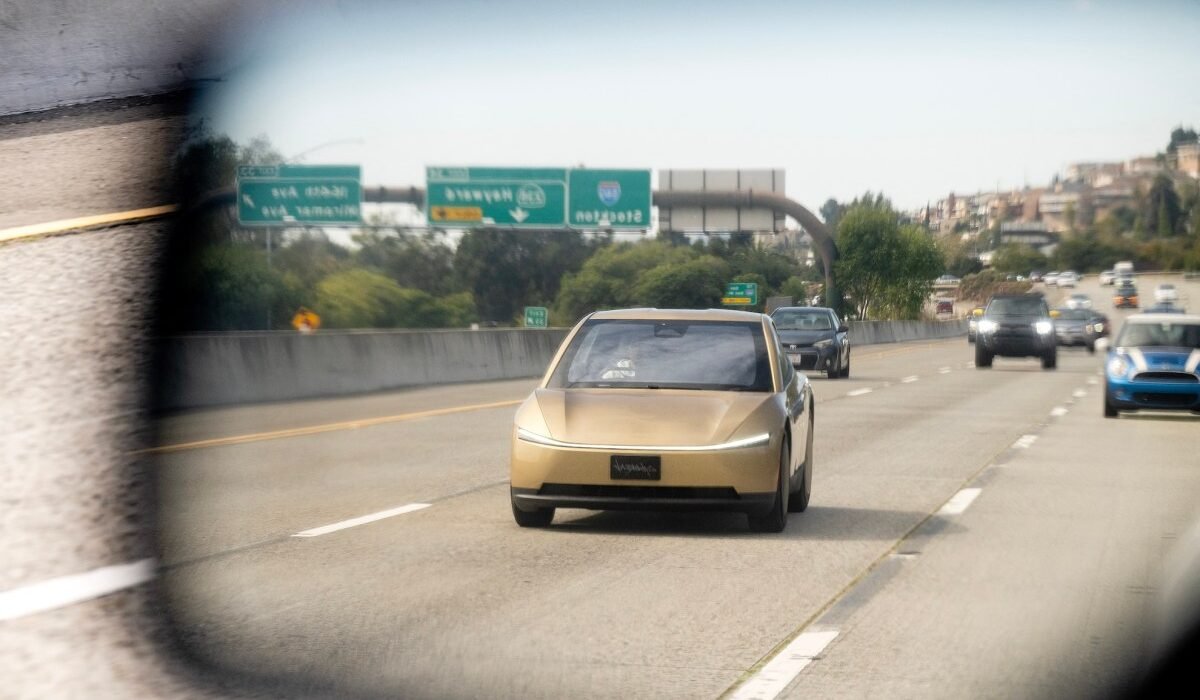
The National Highway Traffic Safety Administration has released a proposal that would let autonomous vehicles display cyan‑colored lights to indicate they are operating without a human driver behind the wheel. The agency is not mandating the use of blue‑green lights, but it suggests they be steady rather than flashing and visible from the front, rear and both sides of the vehicle. The draft also outlines where the lights should be mounted, how they are activated, and it would eliminate the need for manually operated turn signals, high beams and hazard lights when a vehicle is in autonomous mode.
The move is part of a broader effort by NHTSA to modernize safety standards for driverless cars, a task that NHTSA administrator Jonathan Morrison says is essential for speeding adoption while keeping the public safe. Current Federal Motor Vehicle Safety Standards were written for conventional cars and do not address vehicles such as the Tesla Cybercab or Zoox robotaxi, which lack pedals, steering wheels, side mirrors and rear‑view mirrors.
Meanwhile, General Motors used its GM Forward event to detail a sweeping redesign of the electrical and computing architecture that will underpin its future models. The company plans to introduce the new platform in 2028 with the Cadillac Escalade IQ, which will feature faster software updates, more advanced automated‑driving capabilities and a conversational AI assistant intended to replace the three‑decade‑old OnStar service. GM also announced an autonomous highway‑driving function slated for the same year, promising hands‑free operation without requiring the driver to stay ready to take control. The automaker says enterprise‑wide AI adoption will cut its traditional four‑ to five‑year development cycle in half.
In the AI arena, Rivian has acquired UK‑based Third Dimension, a startup that uses artificial intelligence to convert images and video into realistic 3‑D environments. The purchase aims to narrow the “sim‑to‑real gap,” a term coined by Rivian’s head of autonomy James Philbin to describe the disparity between simulated driving data and the physical world. Although the financial terms were not disclosed, the startup previously raised a $7 million seed round and employs roughly 15 engineers, suggesting a modest‑size deal.
Other notable transactions include a memorandum of understanding between ride‑hailing platform inDrive, Chinese autonomous‑driving firm Pony.ai and Nvidia to test robotaxis in Kazakhstan by 2027, and a $115 million Series D extension for Reliable Robotics, a company developing autonomous flight kits for existing aircraft. The round, led by Nimble Partners with debt from Silicon Valley Bank, brings the startup’s valuation above $1 billion.
A Washington Post report highlighted a mysterious anti‑robotaxi group whose origins remain unclear. Earlier this summer, reporting uncovered a similar organization, the Coalition for Accountability and Road Safety, which was linked to a New York lobbying firm that also represents several labor unions and the New York Black Car Operators’ Injury Compensation Fund.
Finally, GM announced the closure of a plant south of Detroit that had produced battery packs for the Cadillac Celestiq and electric drive units and battery packs for the plug‑in hybrid Chevrolet model. The shutdown marks another shift as the company restructures its manufacturing footprint to align with its upcoming technology strategy.