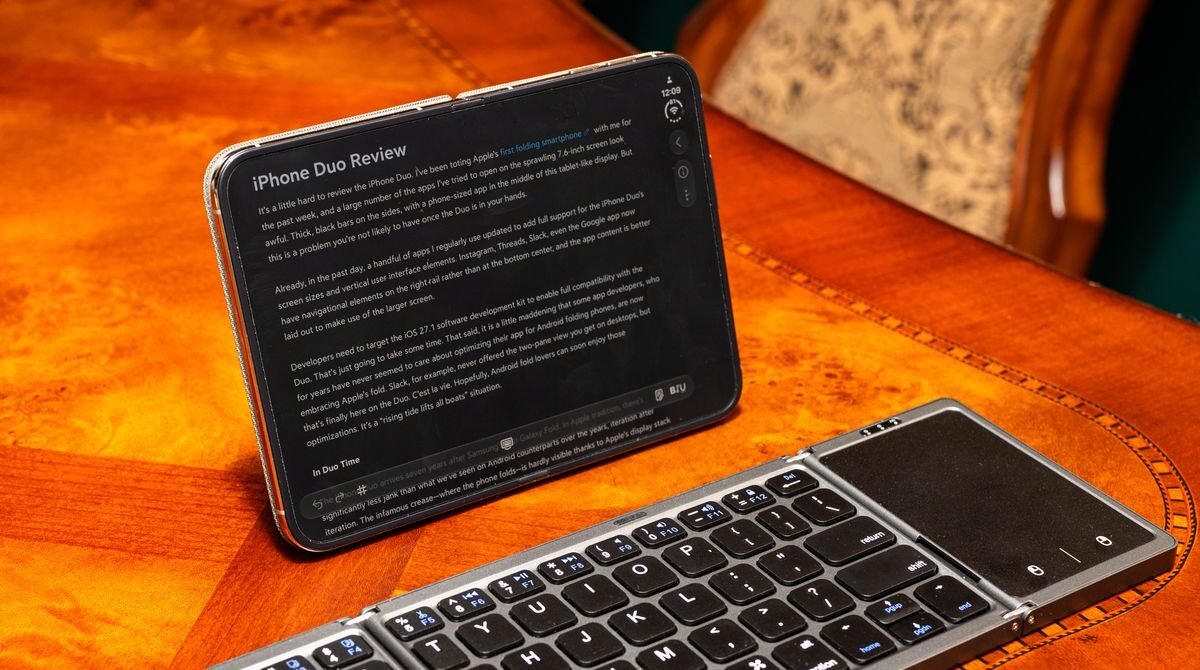
An iPhone 18 Pro costs $1,199 and an iPad starts at $449. Buying both as a primary phone and a portable work tablet brings the total close to the $1,999 price tag of Apple’s first folding phone, the iPhone Duo. The question is whether the Duo’s 7.6‑inch display can truly serve as both a handset and a workstation, and whether the extra cost is justified.
I wrote my entire review of the iPhone Duo on the device itself, using Bear for note‑taking because the app is one of the few that scales nicely to the larger screen. Most other apps still need weeks or months of updates before they look right, a point I cover in detail in the review. Despite the shortcomings, the overall experience was not terrible.
I have tried similar experiments on Android foldables and even on smart glasses with virtual workspaces, but iOS presents its own set of challenges. For instance, iOS does not automatically recognize a Bluetooth mouse or trackpad. To get a cursor, you must enable AssistiveTouch in the accessibility settings, which then provides an iPad‑style pointer for navigating the Duo and selecting text without constantly tapping the screen.
Even with a cursor, simple tasks such as pasting hyperlinks or quickly searching for information felt slower, so I saved those for the end when I transferred everything into WIRED’s content management system. The final polishing still required a switch to my desktop.
Apple also imposes strict multitasking rules in iOS. When you open two apps in split‑screen mode, the screen is divided evenly at 50‑50. Unlike most operating systems that let you drag the divider to allocate more space to one app, iOS forces an equal split. In portrait orientation you cannot stack two apps vertically; the only option is to pin a video app at the top with another app below.
One feature Apple got right is app pairs. You can lock two apps together, and they appear as a single entry in Recents. For example, pairing email and calendar lets you open both with a single tap.
My keyboard of choice was an older Seenda folding Bluetooth model, which is far from perfect. I expect a wave of compact keyboards—from brands like Nillkin or ProtoArc—to appear soon for users who need a portable typing solution. I also used Apple’s iPhone Duo Folio with Kickstand to prop the phone upright. Various MagSafe kickstands, tripods, or cases can serve the same purpose.
Most of the day was spent typing, but I also had to hop between apps to answer coworkers and join a Zoom call. The Slack iOS app had just been updated to fully support the Duo’s larger screen and vertical navigation, making it easy to switch between conversations in a two‑pane view. Apple could still improve by adding a feature similar to the iPad’s Slide Over, which would let you hide a floating app off to the side and bring it back when needed—ideal for messaging apps like Slack, WhatsApp, or Messages without breaking the split‑screen layout.
Zoom was not optimized for the Duo, though my editor commented that the video quality from both the inner and outer selfie cameras was “really good.” I used the folio kickstand to run Zoom on the big screen until I realized the video was stuck in an awkward portrait orientation, so I laid the phone flat and turned the 5.4‑inch outer screen toward my face, creating a more laptop‑like experience.
The most frustrating app was Gmail. While Google updated its Search app for Duo compatibility early in the week, the rest of its workspace suite still looks poor on the device. Full support should arrive soon, possibly by the official launch on Friday. A true two‑pane view in Gmail would be a game changer for clearing inboxes on the go.
By 6 p.m. the battery was still at about 45 percent, which is impressive after roughly six hours of active screen time.
You probably won’t replace your laptop with the iPhone Duo, and anyone used to the iPad’s larger display may find the 7.6‑inch screen cramped. However, with a kickstand and a suitable portable keyboard, handling focused, light work on the Duo is entirely feasible. Things will become even more interesting when Apple Pencil support arrives later this year.
As I packed away my keyboard, a familiar feeling lingered. Perhaps a single all‑in‑one device isn’t as revolutionary as it seems. Maybe a dedicated MP3 player, a standalone camera, a notebook, or a laptop will still have their place. By the way, have you heard that Apple is working on a touchscreen MacBook?